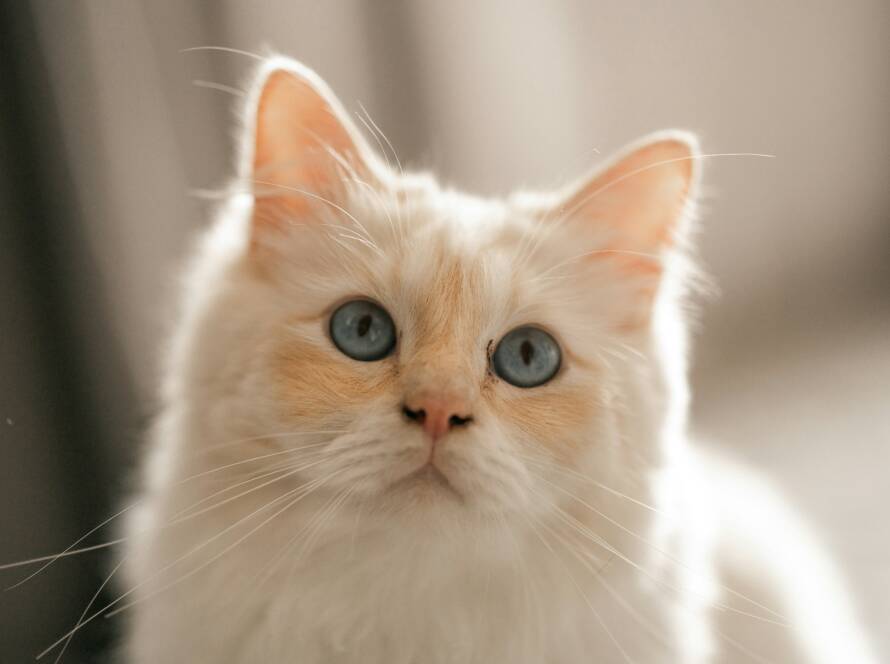
Sometimes, it feels like cats can smile because they occasionally appear to be grinning, particularly when their mouth corners are slightly “upturned,” and their eyes are partially closed. Cats and humans, however, express their emotions in somewhat different ways. We’re wired to read a human-style smile as happiness, while cats rely much more on eye signals, ear position, body posture, tail movement, and context.
In this article, you’ll learn whether cats can physically smile, why a cat might appear to be smiling, and the most reliable signs your cat is truly content.
Can Cats Smile Like Humans?
Short answer: They don’t smile the way we do.
A human smile is a distinct facial expression shaped by human facial anatomy and social norms. Cats do have facial muscles and can move parts of their face, but they don’t typically use a “smile” as a clear, universal happiness signal the way people do. Many veterinarians and behaviour experts explain that what we interpret as a smile is usually just a neutral, relaxed cat face, not a deliberate “happy grin.”
Also, cat communication is less about facial theatrics and more about subtle signals and body language. That’s why two cats can be “saying” very different things while their mouths look the same.
Do Cats Smile With Their Mouth?
A cat’s mouth structure can naturally create the illusion of a smile. The lips and muzzle shape, plus whisker pads, can make the corners look slightly lifted even when your cat is doing nothing special.
Sometimes cats open their mouths for reasons that have nothing to do with happiness:
- Flehmen response: Your cat sniffs something interesting (often a strong smell or pheromone cue), then holds their mouth slightly open to “analyze” the scent using a special organ in the roof of the mouth (the vomeronasal organ). This can look like a goofy grin, but it’s really “scent processing.”
- Panting/open-mouth breathing: Less common in cats than in dogs. If your cat is open-mouth breathing without an obvious smell investigation, especially with fast breathing or distress, that’s a health concern rather than a “smile” situation. In that case, you can contact our vets at York Vet.
Common situations where cats appear to “smile.”
- After waking up, when the face is relaxed
- During gentle petting, when eyes are soft/half-closed
- When doing the flehmen response after smelling a new object
How Cats Actually Show Happiness
Slow Blinking
Slow blinking is one of the clearest “I’m comfortable with you” signals cats use.
A well-known study on cat-human communication found that cats responded more with eye-narrowing/half-blinks when humans slow-blinked at them, and cats showed a greater tendency to approach after a slow-blink interaction compared with a neutral face. The study included 21 cats in one experiment (final analysis on 18 cat-human pairs) and reported higher “approach scores” after slow blinking (average 2.78 vs 2.39).
What to look for: Your cat looks at you, slowly closes their eyes, and reopens them calmly, often while staying relaxed.
Body Language
Cats “smile” with their whole body more than their mouth.
- Relaxed posture: Looser muscles, comfy loaf/sploot positions, no tension
- Tail position: An Upright tail (often with a gentle curve at the tip) can signal friendly confidence
- The “Vulnerable” Belly: Rolling over to show their stomach is a massive sign of trust.
- Warning: This is usually a “look but don’t touch” gesture; for many cats, it’s a sign of relaxation, not an invitation for a belly rub.
- Kneading: Often linked with comfort and security (many cats knead on soft blankets or your lap)
Vocalizations
- High-Pitched Trills: That “brrrpt!” sound is a joyful greeting. Generally, higher pitches indicate happiness, while lower, guttural tones may indicate a demand or annoyance.
- Purring and soft sounds: Purring often happens during comfort, but it’s not a guaranteed “happy only” sign. Cats can also purr when anxious or stressed as a self-soothing behaviour, so always read purring alongside body language and context.
Signs a Cat Is Content or Happy
A “happy cat checklist” usually looks like this:
- Seeks attention (on their terms): head bumps, rubbing, choosing to sit near you
- Plays and shows curiosity: investigates, chases toys, watches the environment calmly
- Eats and grooms normally: steady habits are a big “all is well” indicator
- Comfortable resting positions: belly partially exposed, curled naps, relaxed limbs
- Social comfort: slow blinks, relaxed ears, normal tail movement
Can Cats Show Emotions Through Facial Expressions?
Cats have facial expressions, but they’re often subtle compared to humans.
Interestingly, researchers studying cat facial signalling have documented a large variety of distinct facial configurations in cat-cat interactions. One study observing 53 adult domestic shorthair cats recorded 276 morphologically distinct facial signals, and noted that about 83% were exclusive to either affiliative (friendly) or non-affiliative contexts.
That doesn’t mean cats “smile like humans.” It means cats can be expressive, but we shouldn’t rely on the mouth alone. In daily life, the most useful “facial” cues are usually:
- Eyes: soft gaze, slow blinking
- Ears: forward/neutral vs. pinned sideways/back
- Whiskers: relaxed vs. pushed forward/tightened (often with tension)

Common Myths About Cats Smiling
Myth 1: “If the mouth corners look up, my cat is happy.”
Not necessarily. Many cats look like that even in a neutral mood.
Myth 2: “Cats feel emotions exactly like humans, so a smile must mean joy.”
Cats feel emotions, but they express them differently—and context matters more than a single facial feature.
Myth 3: “Purring always means my cat is happy.”
Purring can also show stress or discomfort, so check posture, ears, and situation.
How to Make Cats Happy
Cats are happiest when their environment supports their instincts for safety control and gentle stimulation, and when their boundaries are respected.
Create a safe space
Cats feel happier when they have quiet, predictable areas where they can rest without disturbance.
Keep a consistent routine
Regular feeding, play and rest times help cats feel secure and reduce stress.
Provide vertical space
High places like cat trees or window perches make cats feel confident and in control of their surroundings.
Play every day
Short daily play sessions that mimic hunting help cats release energy and stay mentally healthy.
Feed in a calm environment
Cats enjoy eating more when food is offered in a quiet area with small, frequent meals.
Use slow blinking
Slow blinking at your cat is a simple way to communicate trust, comfort, and affection.
Respect independence
Allowing your cat to choose when to interact builds confidence and long-term happiness.
Keep the litter box clean
A clean, accessible litter box supports comfort and prevents stress-related behaviours.
Watch their health
A healthy cat with normal appetite, grooming and activity levels is more likely to be content.
Learn your cat’s preferences
Understanding what your individual cat enjoys is key to building a happy relationship.
To conclude, cats don’t usually smile with their mouths the way humans do, but they absolutely show happiness in other, clearer ways. The most trustworthy signs are slow blinking, relaxed body language, and healthy, consistent daily habits.